
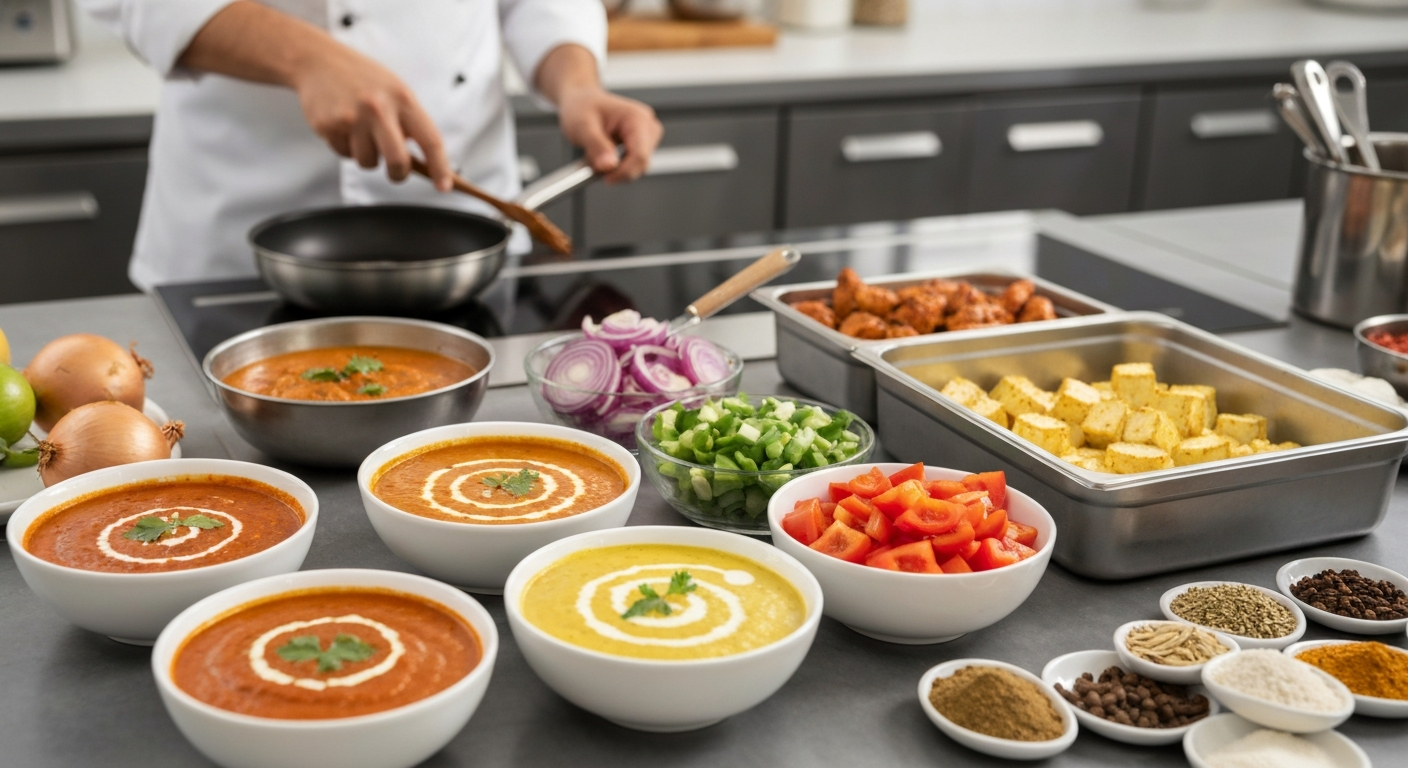
The landscape of the food service industry is rapidly evolving, with multi-brand ghost kitchens emerging as a powerful model for maximizing reach and operational efficiency. For operators looking to tap into the immense popularity of Indian cuisine, the challenge lies in managing the inherent complexity of its diverse ingredients and intricate preparations while maintaining profitability across multiple brands. The key to unlocking this potential lies in intelligent ghost kitchen shared ingredients indian menu strategies.
This article will explore how strategic ingredient cross-utilization, combined with efficient prep and reliable sourcing, can transform your Indian ghost kitchen operations, reduce waste, and significantly boost your bottom line. We'll delve into practical approaches that allow a single kitchen to expertly craft a range of authentic Indian dishes for various brands, all while streamlining your supply chain and labor.
The Multi-Brand Ghost Kitchen Advantage and Its Unique Challenges
Multi-brand ghost kitchens offer a compelling proposition: the ability to cater to diverse customer preferences and capture multiple market segments from a single operational hub. This model reduces overheads associated with traditional brick-and-mortar restaurants, such as front-of-house staff and prime real estate, allowing for greater investment in kitchen technology and ingredient quality.
However, this advantage comes with its own set of operational complexities. Managing inventory for multiple distinct menus, ensuring consistent quality across brands, and optimizing labor for varied preparation tasks can quickly become overwhelming. When it comes to Indian cuisine, these challenges are often amplified due to:
- Diverse Regional Dishes: Indian food encompasses a vast array of regional specialties, each with unique spice profiles and cooking techniques.
- Complex Base Preparations: Many Indian dishes begin with labor-intensive foundational gravies, pastes, and spice blends that require significant time and skill.
- Perishable Ingredients: Fresh produce, dairy, and proteins are central to Indian cooking, necessitating careful inventory management to prevent spoilage and waste.
Without a strategic approach to ingredient management, multi-brand Indian ghost kitchens risk inventory bloat, inconsistent product quality, higher food costs, and inefficient labor utilization. The solution lies in a thoughtful approach to menu engineering and ingredient cross-utilization.
Foundation of Profitability: Strategic Menu Engineering for Indian Dishes
Profitability in a multi-brand ghost kitchen begins long before a dish is cooked—it starts with menu engineering. For Indian cuisine, this means designing menus for each brand with an eye towards common denominators. The goal is to identify core ingredients and foundational preparations that can serve as the building blocks for a wide array of dishes across your different brands.
Consider the commonality in many popular Indian dishes:
- Onion-Tomato Gravy Base: This forms the foundation for countless curries, from a rich Chicken Tikka Masala to a tangy Chana Masala or a hearty Aloo Gobi.
- Ginger-Garlic Paste: A ubiquitous aromatic base, essential for almost all savory Indian preparations.
- Cashew or Nut Pastes: Used to create creamy textures in dishes like Korma or Malai Kofta.
- Yogurt-Based Marinades: Crucial for tandoori items, kebabs, and some curries.
By standardizing these core bases, you can dramatically reduce prep time, minimize waste, and ensure consistent flavor profiles across your entire Indian menu portfolio. For instance, a single batch of high-quality Makhani gravy can be portioned and customized to create Butter Chicken for one brand, Paneer Butter Masala for another, and even a unique vegetable curry for a third, simply by varying the protein or vegetable and adding a few finishing touches.
Leveraging chef-grade, pre-made gravies and pastes from a reliable supplier like MITRA further enhances this strategy. These products are manufactured to stringent standards, providing a consistent, authentic flavor base that dramatically cuts down on labor and ensures quality control, allowing your kitchen staff to focus on customization and plating rather than hours of laborious scratch preparation.
Implementing Smart Ingredient Cross-Utilization in Your Indian Kitchen
Effective cross-utilization requires a systematic approach, transforming your kitchen into a hub of efficiency. Here’s how to implement it for your Indian menus:
Standardized Core Bases and Pastes
This is perhaps the most impactful area for cross-utilization. Instead of preparing separate gravies for each dish or brand, invest in high-quality, authentic base gravies that can be adapted. For example:
- Makhani Gravy: The rich, buttery base can be used for Butter Chicken, Paneer Butter Masala, Dal Makhani, or even a creamy vegetable curry.
- Tikka Gravy: A robust, spiced tomato-onion base perfect for Chicken Tikka Masala, Paneer Tikka, or a variety of dry vegetable stir-fries (sabzis).
- Korma Gravy: A mild, creamy, and nutty base suitable for Chicken Korma, Navratan Korma (nine-jewel vegetable curry), or even a delicate fish preparation.
MITRA's range of chef-grade Indian gravies and pastes are designed precisely for this purpose. They offer the authentic flavor and consistency required, eliminating the need for extensive scratch cooking of these complex bases. This not only saves significant labor hours but also ensures a consistent product across all your brands, batch after batch.
Spice Blends and Aromatic Oils
Indian cuisine is defined by its spices. Instead of mixing small batches for every dish, optimize by:
- Batch Preparing Tadkas: A `tadka` (tempering) of cumin seeds, mustard seeds, and curry leaves in oil can be prepared in larger quantities and used as a flavor base for multiple dals, vegetable dishes, or even rice preparations.
- Universal Garam Masala: While specific spice blends exist, a well-balanced house-made or high-quality commercial `garam masala` can be a unifying element across many dishes.
- Infused Oils: Prepare chili oil, garlic oil, or ginger oil in bulk to add quick flavor boosts to various curries, marinades, or garnishes.
- Pre-Portioned Spice Mixes: For specific, high-volume dishes, pre-mix and portion the required ground spices to ensure consistency and speed during service.
Protein and Vegetable Versatility
Many proteins and vegetables are common across Indian dishes. Maximize their use:
- Common Proteins: Chicken, paneer, chickpeas, and lentils are staples. Batch cook lentils (e.g., moong dal, masoor dal) that can be seasoned differently for various dal preparations. Marinate chicken or paneer in bulk with a neutral base, then customize with specific spice blends per brand.
- Pre-Cut Vegetables: Onions, bell peppers, tomatoes, and potatoes are widely used. Centralize their prepping and cutting to supply all brands, ensuring consistent sizing and reducing individual prep time.
- Blanched Vegetables: Blanch common vegetables like cauliflower, green beans, or carrots in advance. They can then be quickly added to different gravies or stir-fries as needed.
Operational Efficiency: Beyond Ingredients
Smart ingredient cross-utilization extends beyond just what you use; it encompasses how you manage your entire kitchen operation.
Centralized Prep and Storage
Design your ghost kitchen layout to facilitate centralized prep. Designate specific stations for washing, chopping, and mixing ingredients that will be shared across all brands. Implement a robust FIFO (First-In, First-Out) inventory system, ensuring proper labeling with dates and contents to minimize waste and maintain freshness. Adequate, organized cold storage is paramount for bulk-prepped ingredients.
Staff Training and Workflow Optimization
Your team is your greatest asset. Train staff comprehensively on the cross-utilization strategy, emphasizing standardized recipes for core components and clear instructions for customizing dishes for each brand. Visual recipe cards with precise measurements and steps are invaluable. Optimize workflow by sequencing tasks: bulk prep in the morning, followed by specific brand assembly during peak hours. Leveraging kitchen display systems (KDS) can further streamline order management and ensure timely execution across multiple brands.
Supply Chain and Procurement
Strategic procurement is critical. Bulk purchasing of ghost kitchen shared ingredients indian menu items reduces per-unit costs and ensures consistent supply. Establish strong relationships with reliable suppliers who can guarantee the quality and consistency of your ingredients. This is where a partner like MITRA becomes essential. Our commitment to supplying chef-grade Indian gravies, pastes, sauces, rice, and spices means you receive consistent quality that supports your cross-utilization efforts, simplifying your supply chain and reducing procurement complexities.
The MITRA Advantage: Elevating Your Indian Ghost Kitchen
At ODOD LLC, under our MITRA brand, we understand the unique demands of professional kitchens, especially multi-brand ghost kitchens focused on Indian cuisine. Our products are specifically developed to support the strategies discussed, offering a significant advantage:
- Consistent, Chef-Grade Quality: Our products are manufactured to exacting standards, ensuring authentic Indian flavors and textures that remain consistent across every batch. This eliminates the variability inherent in scratch preparation, guaranteeing a reliable base for all your Indian brands.
- Significant Labor Savings: By providing ready-to-use, high-quality gravies and pastes, we drastically reduce the labor hours spent on foundational cooking, allowing your chefs to focus on customization, plating, and innovation.
- Reduced Food Waste: Our bulk packaging and consistent product quality facilitate better inventory management and portion control, leading to less spoilage and waste.
- Scalability and Efficiency: With MITRA products, scaling your Indian menu offerings across multiple brands becomes simpler and more efficient, enabling rapid expansion without compromising quality.
- Assured Compliance: Our products are manufactured to global food safety and quality standards, holding FSSAI, US FDA, ISO, Halal, HACCP, and GMP certifications, providing peace of mind for your operations.
- Reliable Supply Chain: We serve a growing list of countries, including USA, Canada, UK, UAE, Australia, Germany, Italy, India, France, Ireland, Switzerland, and Netherlands. Our minimum order quantity (MOQ) is 50 kg. For products in stock in our US (Houston) or local-country warehouse, orders ship in 2 days. If an item is not in stock, the lead time is 35-60 days, and customers are notified immediately of any potential delays.
Conclusion
Operating a profitable multi-brand Indian ghost kitchen hinges on intelligent ingredient management. By embracing smart cross-utilization strategies, centralizing prep, optimizing workflow, and partnering with reliable suppliers for consistent, chef-grade ingredients, you can transform operational complexities into competitive advantages. This approach not only reduces food costs and labor expenditure but also ensures a consistently high-quality culinary experience across all your Indian brands.
Invest in strategy, streamline your operations, and let the power of ghost kitchen shared ingredients indian menu optimization drive your profitability. To learn more about how MITRA's range of products can support your ghost kitchen's success, we invite you to inquire via ododgroup.com.