
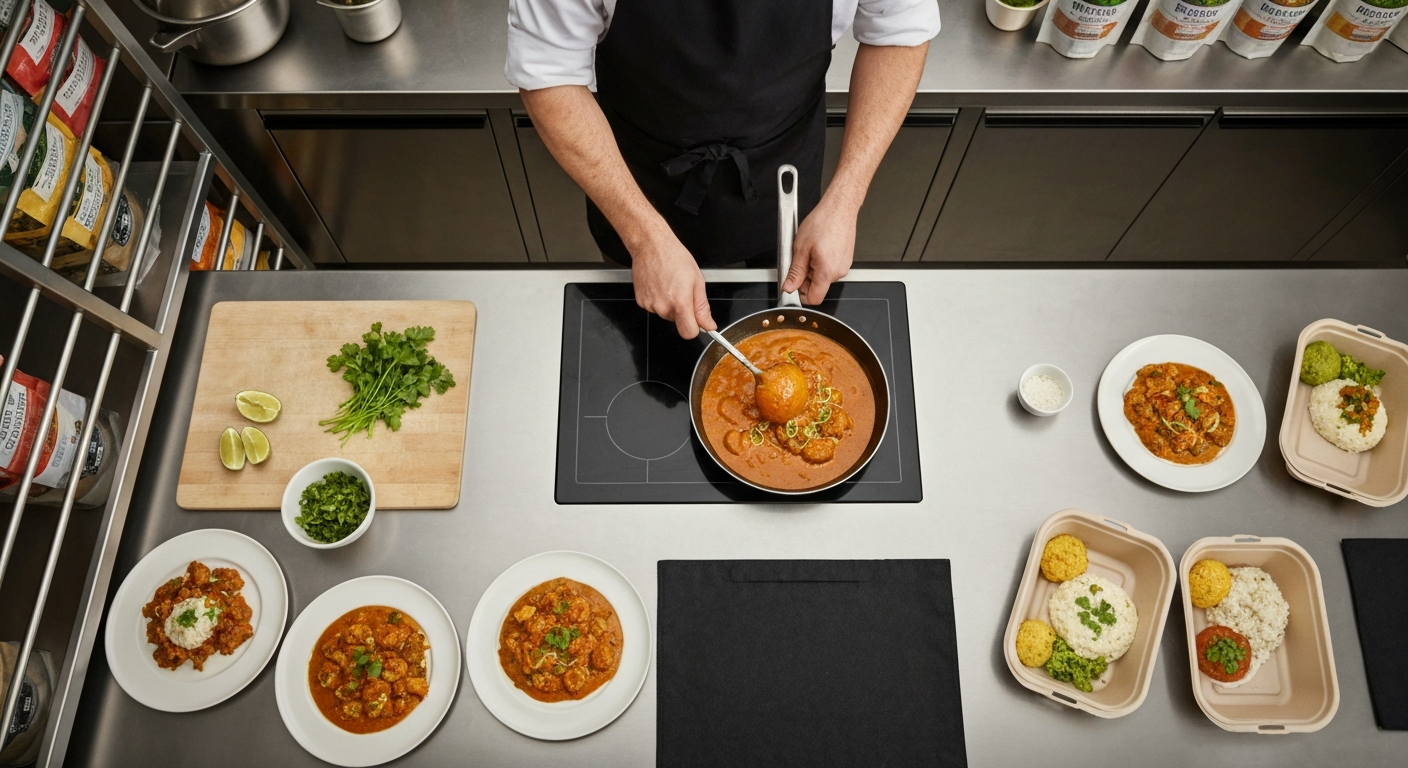
The rise of ghost kitchens has reshaped the restaurant landscape, offering culinary entrepreneurs a pathway to market with lower overheads. However, operating a high-volume, diverse menu from a compact space presents unique challenges, especially when it comes to a cuisine as intricate and ingredient-rich as Indian food. For operators focused on ghost kitchen Indian menu space optimization, the goal is to maximize efficiency without compromising authenticity or flavor.
Traditional Indian cooking often demands extensive prep, a wide array of spices, multiple cooking stations, and specialized equipment. In a ghost kitchen setting where every square foot counts, this can quickly become a bottleneck. This article explores strategic layout principles and operational solutions, highlighting how premium, chef-grade Indian gravies and pastes from MITRA can be a cornerstone for achieving remarkable efficiency and consistency in a small footprint.
The Intricacies of Indian Cuisine in a Compact Kitchen
Indian cuisine is celebrated for its complexity, depth of flavor, and regional diversity. A single Indian dish can involve a dozen or more spices, slow-cooked gravies, intricate tempering, and fresh aromatics. For a commercial kitchen, this translates to:
- Extensive Mise en Place: Chopping, dicing, grinding, and blending large quantities of onions, tomatoes, ginger, garlic, and fresh herbs daily.
- Diverse Spice Inventory: Requiring dedicated storage and careful management of whole and ground spices, often roasted or tempered individually.
- Multiple Cooking Stages: Many dishes involve distinct steps performed in separate pans or at different temperatures, occupying multiple burners simultaneously.
- Specialized Equipment: While not always mandatory, items like large tawas, tandoors, or commercial spice grinders can be beneficial for authenticity and scale, yet demand significant space and ventilation.
- Labor-Intensive Preparation: Skilled chefs are often required for the foundational work of gravies and spice blends, which can be time-consuming and costly.
In a ghost kitchen, these factors can quickly lead to cramped workstations, inefficient workflows, and increased labor costs, directly impacting profitability and scalability. The key to success lies in smart design and innovative product solutions.
Strategic Layout Principles for Indian Ghost Kitchens
Optimizing a ghost kitchen layout for Indian cuisine begins with fundamental design principles tailored to the specific demands of the menu.
1. Workflow-Driven Design
Design the kitchen around a logical flow of operations: receiving, storage, prep, cooking, plating, and dishwashing. Minimize cross-traffic and unnecessary movement. For Indian food, this means considering the journey from raw ingredients (or pre-made bases) to finished dishes.
2. Zoning for Efficiency
Divide the kitchen into distinct zones. For an Indian menu, these might include:
- Dry Storage: Spices, rice, pulses.
- Cold Storage: Dairy, meats, vegetables, pre-made gravies.
- Wet Prep: Washing, cutting vegetables.
- Hot Line/Cooking: Stoves, griddles, ovens.
- Plating/Pass: Where dishes are finished and dispatched.
- Dishwashing: Essential for hygiene and turnaround.
Each zone should have the necessary equipment and access to ingredients to minimize travel time between tasks.
3. Vertical Space Utilization
In compact kitchens, going vertical is crucial. Use shelving, wall-mounted racks, and pot racks to store ingredients, small equipment, and utensils. This frees up valuable counter space for active prep and cooking.
4. Multi-Functional Equipment
Invest in equipment that can serve multiple purposes. For example, a combi oven can roast, steam, and bake, reducing the need for separate appliances. Induction cooktops offer precise control and are more energy-efficient than gas, often requiring less ventilation.
How MITRA Products Revolutionize Ghost Kitchen Indian Menu Space Optimization
This is where MITRA's range of chef-grade Indian gravies, pastes, and sauces becomes a game-changer for ghost kitchens. By integrating these high-quality, authentic bases, operators can dramatically reduce the space, equipment, and labor traditionally required for Indian cuisine.
Reduced Prep Area Needs
One of the biggest space consumers in a traditional Indian kitchen is the prep area for foundational ingredients. Imagine the counter space, cutting boards, and storage needed for hundreds of pounds of onions, tomatoes, ginger, and garlic daily. With MITRA's ready-to-use gravies and pastes:
- Eliminate Bulk Chopping: No need for large cutting stations, food processors, or dedicated staff for chopping base vegetables.
- Minimize Grinding: Skip the need for commercial blenders or spice grinders for wet masalas.
- Less Ingredient Storage: Reduce the volume of raw produce requiring refrigeration or dry storage.
This directly frees up significant counter space, allowing for smaller prep zones or repurposing areas for other tasks.
Fewer Cooking Stations and Equipment
Traditional Indian gravies often require long simmering times, taking up valuable burner space for hours. MITRA products streamline this process:
- Faster Cook Times: Our gravies are already slow-cooked to perfection. Chefs simply combine them with proteins or vegetables, reducing active cooking time from hours to minutes.
- Reduced Burner Dependency: A single pan can be used to finish a dish, rather than multiple pans for separate gravy bases, tempering, and final cooking.
- Less Specialized Gear: The need for large stock pots for gravy bases, or extensive spice tempering equipment, is significantly reduced. This means fewer pieces of bulky equipment, which translates to more open floor space.
Consistent Quality, Simplified Operations
Space optimization isn't just about square footage; it's also about optimizing human effort and output consistency. With MITRA products:
- Standardized Flavor: Every batch delivers consistent, authentic Indian flavor, reducing reliance on individual chef skill for gravy bases.
- Reduced Training Time: New staff can quickly learn to produce high-quality Indian dishes, as the most complex part of the cooking process is already handled.
- Higher Throughput: Faster cooking allows kitchens to fulfill more orders in less time, maximizing revenue from a limited space.
Designing for Efficiency: Zone by Zone with MITRA
Let's consider how MITRA products impact specific zones within an Indian ghost kitchen:
Receiving & Storage
Instead of pallets of raw vegetables and numerous spice sacks, you'll primarily receive and store ready-to-use gravy pouches or tubs. This simplifies inventory management and reduces storage footprint. Our products are manufactured to stringent standards, including FSSAI, US FDA, ISO, Halal, HACCP, and GMP, ensuring quality and safety from delivery to plate. A minimum order quantity (MOQ) of 50 kg applies, ensuring you have ample supply for high-volume operations.
Prep Zone
This zone shrinks considerably. Focus shifts from laborious chopping to quick portioning of proteins or vegetables. The space saved can be reallocated to plating, additional cold storage, or even a small dedicated area for specialty items not covered by pre-made bases.
Hot Line/Cooking Zone
This becomes a finishing station. Chefs combine MITRA gravies with pre-cooked or quickly-cooked proteins/vegetables, bring to a simmer, and plate. Fewer burners are needed, and the overall pace of service accelerates. This allows for a more compact hot line, potentially freeing up space for a small dedicated area for rice cookers or bread warming.
Plating & Dispatch
With faster cooking times, the plating area needs to be highly efficient to handle increased throughput. A well-designed pass-through system and clear labeling are crucial to ensure orders are assembled accurately and dispatched quickly.
Beyond Layout: Operational Advantages for Ghost Kitchens
The benefits of integrating MITRA products extend beyond physical space optimization:
- Reduced Labor Costs: Less need for highly skilled chefs for foundational gravy preparation, allowing staff to focus on finishing and presentation.
- Waste Reduction: Pre-portioned gravies reduce spoilage of raw ingredients and minimize batch cooking errors.
- Scalability: Easily replicate menu items across multiple ghost kitchen locations with consistent quality, facilitating rapid expansion.
- Menu Expansion: The freed-up space and labor allow for greater flexibility to introduce new Indian dishes or explore different regional cuisines without extensive reconfigurations.
- Global Reach: ODOD LLC ships to a growing number of countries, including USA, Canada, UK, UAE, Australia, Germany, Italy, India, France, Ireland, Switzerland, and Netherlands. If products are in stock in our US (Houston) or local-country warehouses, they ship in 2 days. For items not in stock, the lead time is 35-60 days, and customers are notified immediately of any delay.
Partnering for Success in the Compact Kitchen
For ghost kitchen operators, caterers, and food distributors aiming to master ghost kitchen Indian menu space optimization, MITRA products offer a strategic advantage. By simplifying complex culinary processes without sacrificing authentic Indian flavors, kitchens can achieve higher efficiency, greater consistency, and improved profitability in even the most compact environments.
Ready to transform your Indian ghost kitchen operation? Explore the MITRA range of chef-grade gravies, pastes, sauces, rice, and spices. Inquire today via ododgroup.com to learn how our products can streamline your kitchen, reduce equipment needs, and elevate your menu.